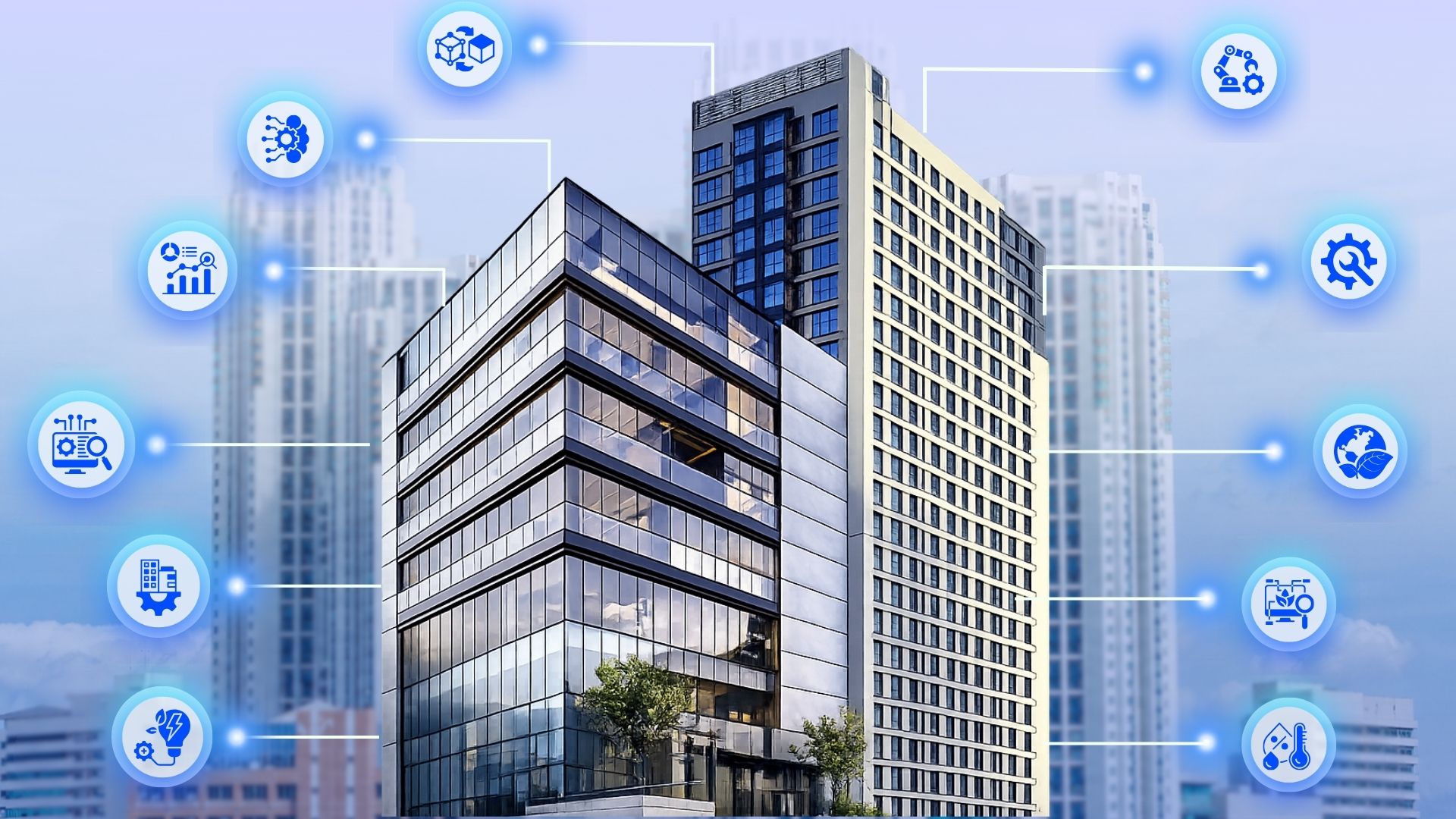
For nearly half a century, Building Management Systems (BMS) have been the backbone of commercial and institutional facilities, managing HVAC, lighting, power, and safety systems. But today's facilities are far more complex, with rising energy costs, sustainability goals, and increasing demands for operational efficiency, making traditional monitoring and control no longer sufficient.
This shift is driving a fundamental transformation: the transition from a traditional Building Management System to what is increasingly referred to as "intelligent operations." This evolution is not just a rebranding exercise. It represents a genuine change in how facilities are designed, monitored, and run from reactive, siloed control systems to proactive, data-driven ecosystems that learn, predict, and optimize. Central to this transformation is the rise of the digital twin technology - a living, virtual replica of the physical building that continuously learns from real-time data and turns operational complexity into actionable intelligence.
What Is a Building Management System and Where Does It Fall Short?
At its core, a Building Management System (BMS), sometimes called a Building Automation System (BAS), is a computer-based control system that monitors and manages a building's mechanical and electrical equipment, including HVAC, lighting, power systems, fire response, and security.
A traditional Building Management System operates on rules-based logic: if a temperature exceeds a setpoint, the system triggers cooling; if a door sensor detects unauthorized access, an alarm fires. These systems have delivered real value for decades, improving energy efficiency, reducing manual oversight, and providing centralized control over scattered infrastructure.
However, conventional Building Management Systems were designed for a different era, one where occupancy patterns were predictable and operational stability was the primary goal. As facilities have grown more complex, their limitations have become harder to ignore:
- Siloed architecture subsystems like HVAC, lighting, and security operate independently, with little cross-system intelligence. A Building Management System may know a room is overheating, but have no awareness that the room has been vacant for three hours.
- Reactive, not predictive systems respond to conditions after they occur rather than anticipating and adjusting proactively.
- Limited data utilization BMS platforms collect substantial data but lack the analytical capability to convert it into actionable insight, often storing it in proprietary formats that resist integration.
- Inflexible infrastructure upgrades are costly and complex, requiring proprietary hardware and specialized technicians even for minor changes.
These limitations have not diminished the foundational value of the Building Management System; rather, they have created the conditions for an evolutionary leap toward something far more capable.
The Rise of Intelligent Operations
Intelligent operations are best understood not as a single product but as a layered capability stack that sits on top of and progressively enhances the traditional BMS function. It is defined by several core shifts in how buildings are managed:
- From point data to contextual data Platforms, ingest data from the BMS, IoT sensors, utility meters, weather feeds, and occupancy systems, normalizing and tagging it with context so it becomes machine-readable and analyzable at scale.
- From monitoring to prediction Machine learning models trained on historical equipment behavior detect subtle anomalies weeks before a conventional alarm threshold would trip.
- From static schedules to dynamic optimization HVAC and lighting continuously adjust based on real-time occupancy, weather forecasts, and energy prices rather than running on fixed schedules.
- From portfolio visibility Cloud-native architectures aggregate data across dozens or hundreds of buildings, enabling benchmarking, outlier detection, and portfolio-wide performance management.
The technologies enabling this transition, IoT sensors, cloud computing, open APIs, artificial intelligence, and machine learning, are well established. But it is the digital twin that serves as the connective tissue, bringing these capabilities together into a coherent, living representation of the physical building.
Digital Twins: The Core of Intelligent Operations
A digital twin is a virtual, real-time replica of a physical building, continuously updated with live data streams from the Building Management System , IoT sensors, energy meters, and occupancy systems. Unlike a static BIM (Building Information Model), which captures a building's design intent, a digital twin reflects the building's actual, current operational state at every moment.
In the context of intelligent operations, the digital twin performs several critical functions that transform how facilities are managed.
- Real-time operational visibility
- Equipment performance benchmarking
- Energy and comfort optimization
Simulation Before Action
One of the most powerful aspects of the digital twin is the ability to simulate changes before implementing them in the real world. Facility managers can model the impact of a new tenant layout on HVAC load, test the effect of a lighting retrofit on energy consumption, or evaluate different maintenance schedules for critical equipment, all within the virtual environment, without risk or disruption to the actual facility. This capability fundamentally changes the decision-making process, replacing costly trial and error with confident, data-backed planning.
Predictive Maintenance at a New Level of Precision
When a digital twin is trained on historical performance data from the Building Management System, it develops a nuanced understanding of how equipment behaves under different conditions. This makes it exceptionally powerful for predictive maintenance. A chiller whose approach temperature is creeping upward, an air handling unit whose filter is loading faster than usual, or a pump bearing showing abnormal vibration, the digital twin can surface these early-warning signals weeks or months before failure would occur.
This represents a decisive move away from both reactive maintenance (fixing things after they break) and time-based preventive maintenance (servicing equipment on a fixed schedule regardless of condition) toward true condition-based maintenance driven by real operational data.
Dynamic Optimization of Building Systems
A digital twin does not merely observe, but actively informs and, increasingly, drives optimization. By combining live data from the Building Management System with predictive models for occupancy, weather, and energy pricing, the digital twin can continuously recommend or autonomously execute adjustments to setpoints, schedules, and operational sequences.
For example, rather than a fixed morning warm-up schedule for HVAC , the digital twin calculates the optimal pre-conditioning window based on that day's weather forecast, expected occupancy from access control data, and the current thermal state of the building envelope. The Building Management System executes the commands; the digital twin determines what those commands should be.
ESG and Sustainability Reporting
As organizations face mounting pressure to report on environmental performance, the digital twin provides an unparalleled layer of transparency. Because it continuously maps energy consumption to specific systems, zones, and time periods, it produces the granular, auditable data needed for credible ESG disclosures. Organizations can track progress against carbon reduction targets in real time, model the impact of proposed efficiency measures before committing capital, and generate regulatory-ready reports directly from operational data.
How Digital Twins Build on Rather Than Replace the BMS
A critical point for facility owners and managers: the digital twin does not replace the Building Management System. The BMS remains the essential operational layer responsible for direct, real-time control of physical equipment, opening dampers, adjusting setpoints, and cycling pumps. What the digital twin adds is the intelligence layer sitting above this foundation.
This layered model is strategically important because it allows organizations to preserve their existing investment in Building Management System infrastructure while incrementally adding capability. There is no need for a costly and disruptive rip-and-replace program. Instead, data from the existing BMS is fed into the digital twin platform via APIs or data connectors, and intelligence is added progressively, starting perhaps with predictive maintenance, expanding to dynamic optimization, and eventually enabling portfolio-level benchmarking across multiple facilities.
Challenges to Navigate
The transition to digital twin-enabled intelligent operations is not without obstacles. Data quality is perhaps the most significant: many organizations operate with a patchwork of legacy Building Management Systems from different manufacturers, with inconsistent data standards and tagging conventions. Integrating this fragmented landscape into a coherent digital twin requires substantial effort in data normalization.
Cybersecurity is another concern. As the Building Management System becomes connected to cloud platforms and exposed to broader networks, the attack surface expands. Robust practices, such as network segmentation, regular patching, and strict access control, are non-negotiable. And organizational readiness matters as much as technical capability; facility teams need new skills to interpret digital twin outputs and act on AI-generated recommendations.
Conclusion
The journey from a conventional Building Management System to intelligent operations, anchored by the digital twin, represents one of the most significant shifts in the history of facility management. The BMS remains the essential operational backbone, but its role is evolving from a standalone control system into the data foundation of a continuously learning, self-optimizing building ecosystem.
Organizations that successfully make this transition will benefit from lower operating costs, reduced unplanned downtime, stronger sustainability outcomes, and an occupant experience that adapts intelligently to how their buildings are used. The future of smart facilities does not lie in replacing the Building Management System, it lies in elevating it, with the digital twin as the engine that makes that elevation possible.